


Overview
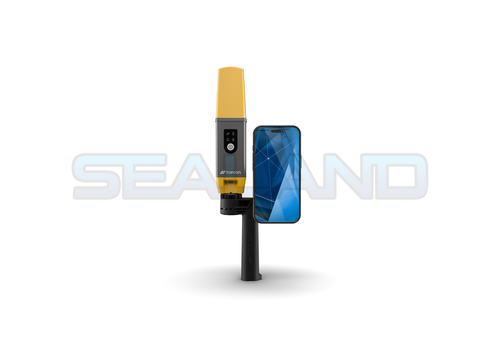
Handheld scanning made simple! Topcon's latest collaboration with Pix4D brings us the CR-H1 handheld scanner, a system which combines LiDAR (Light Detection and Ranging), photogrammetry, and RTK for centimetre accuracy scans. The CR-H1 kit uses Topcon and Apple technologies to create intricate point clouds that greatly benefit the construction and building industry.
The kit is split up into four components: the Topcon HiPer CR GNSS receiver, a TopNET Live RTK corrections license, a Pix4D Catch professional software license on an iPhone Pro/Pro Max, and a Pix4D Cloud software license.
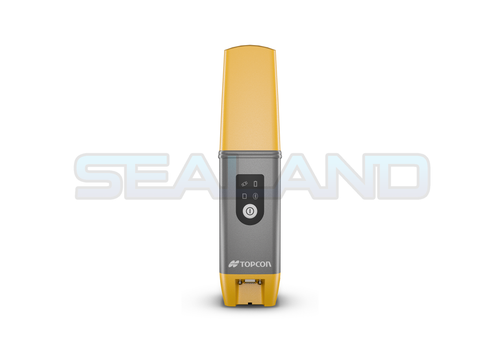
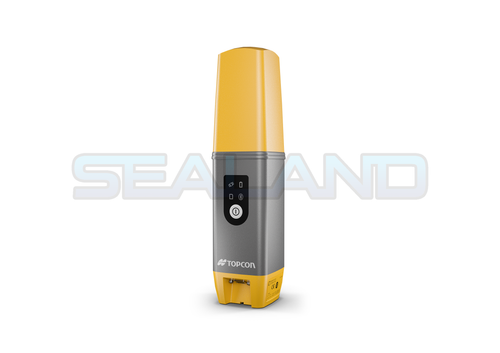
The HiPer CR GNSS Receiver is lightweight, and its design, which is entirely different to any Topcon GNSS Receiver we’ve seen in the past, makes it the perfect shape/size for the dual GNSS and phone holder, which is included in the kit. It features Topcon’s patented Universal Tracking Channel technology, tracking 226 channels across GPS, GLONASS, Galileo, Beidou, SBAS and QZSS. The HiPer CR is Topcon’s most advanced network-only rover yet. With a full battery, you can expect up to 10 hours of use in the field, and with a USB Micro-AB charging port, you can connect to a power bank for a battery top-up on the go.
The HiPer CR
The HiPer CR GNSS Receiver is lightweight, and its design which is entirely different to any Topcon GNSS Receiver we’ve seen in the past makes it the perfect shape/size of the dual GNSS and phone holder which is included in the kit. It features Topcon’s patented Universal Tracking Channel technology, tracking 226 channels across GPS, GLONASS, Galileo, Beidou, SBAS and QZSS. The HiPer CR is Topcon’s most advanced network only rover yet. On a full battery, you can expect to see up to 10 hours usage in the field and with a USB Micro-AB connectivity/charging port, you can connect to a power bank for a battery top up on the go.
Specification
IP67, fully dust proof
8GB internal memory
L - 197mm W - 47mm H - 47mm
<5 hours charging, if connected to 2 A power source
226 Channels, Universal Tracking Channel technology
GPS, Glonass, Galileo, BeiDou, SBAS, QZSS
Protocols: TPS, RTCM, CMR/CMR+, NMEA, BINEX
LongLink Bluetooth technology MINTER (minimum interface) 1 Button, 4 LED
Internal Battery 3.6V
Up to 10 hours operating time
Weight 440g
USB Micro-AB Charging
iPhone Pro/Pro Max (Not sold with kit)
The iPhone Pro models include LiDAR technology, which is vital for scanning and creating the Gaussian splats which we see as photorealistic 3D scenes. Using Pix4D Catch Professional software also allows us to use Augmented Reality for points and project display. In 2020, Apple introduced their ‘Pro’ range of devices, which includes a LiDAR sensor, and with 1.38 billion Apple smartphone users globally, it makes the iPhone Pro the perfect partner for up-and-coming mobile scanning technologies.
Pix4D
Pix4D was founded in 2011 by a computer vision lab in Switzerland. The Pix4D product suite assists the brand fit into a whole host of industries worldwide, such as Agriculture, Construction, Mapping, Inspection, and the Military. Its technologies have been implemented in maintaining some of the world's most famous landmarks, such as Christ the Redeemer in Brazil and the Matterhorn mountain in Switzerland. It’s no surprise that Topcon registered its interest in working with Pix4D when you look at their portfolio.
So, Pix4D catch, what does it do? Pix4D Catch was released in 2020 after confirming their technologies could expand to handheld data capture with the release of the iPhone Pro series. It provides its users with mobile scanning and AR visualisation capabilities. So far, Pix4D Catch has made its way in with Archaeology, Construction and Forensics. Combining Pix4D Catch with RTK allows us to achieve centimetre accuracy for scans in terms of geolocation, without the need for scanning targets/reference points. Users can collect scan data, as well as allowing users to use Augmented Reality features, such as being able to visualise AutoCAD DXF and Industry Foundation Classes (IFC) designs over real-world data for on-site validation purposes.
Finally, Pix4D Cloud software… this really is the cherry on top of an already exceptional piece of kit. The use of Pix4D Cloud can help us elevate our scan data by highlighting specific elements to provide detailed annotations, measuring heights/distances on a scan, and allowing us to monitor job progress by holding multiple scans in one project. For example, if you’re a structural engineering firm building a multi-storey car park, you can scan each section of the build and display it all within one project to share with your client, as well as overlaying design work onto your scans. Pix4D Cloud also allows the user to calculate and compare volumes, and generate a plethora of reports which can be exported for sharing. The project itself, as well as the reports, are time/date stamped to help keep an eye on progress.
 Yes
Yes  No
No 


